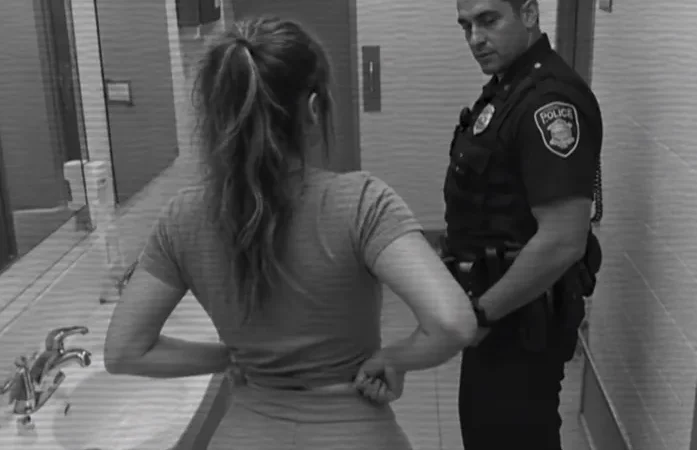
What was supposed to be an ordinary moment quickly turned into something no one expected.
A police officer was being escorted away from the scene when one small detail apparently went unnoticed — the camera was still recording.
And what it captured afterward became the part of the story that drew the most attention.
In an age where cameras are almost everywhere, a moment that once might have disappeared as soon as it happened can now be recorded, replayed, shared, and examined by thousands of people.
That is exactly what made this situation so striking.
The Camera Never Stopped
At first, there appeared to be nothing particularly unusual about the footage.
The officer could be seen dealing with a tense situation while people nearby watched closely. Voices could be heard in the background, and the atmosphere seemed increasingly uncomfortable.
Then the situation changed.
The officer was taken away from the immediate scene, apparently believing that the recording had already ended.
It hadn’t.
The camera continued capturing what happened next.
Without the awareness that people might eventually see or hear those moments, the atmosphere became noticeably different. The formal behavior associated with being on duty seemed to disappear, revealing a much more personal side of the situation.
That unexpected continuation of the recording is what ultimately attracted so much attention.
Viewers Focused on What Happened Afterward
Once footage like this begins circulating online, people naturally start examining every detail.
Some viewers focused on the officer’s behavior before he was taken away. Others were far more interested in what the camera captured afterward.
The incident quickly became a reminder of how difficult it has become to know when a private moment is actually private.
Body cameras, security cameras, smartphones, dashboard cameras, and livestreams have transformed the way incidents involving police officers are documented.
A conversation or reaction that might once have disappeared forever can now become the most closely watched part of an entire encounter.
A Moment Behind the Uniform
One reason footage involving police officers often attracts intense attention is the responsibility associated with the uniform.
Officers are expected to remain professional during stressful, unpredictable, and sometimes dangerous situations. At the same time, they are human beings who experience fear, frustration, confusion, and pressure just like everyone else.
Moments captured unexpectedly can sometimes reveal that tension more clearly than an official statement ever could.
That does not automatically prove wrongdoing, nor does a short video always provide enough context to understand everything that happened.
But it can raise important questions.
What happened before the recording began?
Why was the officer taken away?
What happened immediately afterward?
And perhaps most importantly, does the available footage show the entire story?
Social Media Quickly Forms Its Own Verdict
Whenever unusual footage appears online, reactions often arrive long before all of the facts do.
Some viewers may immediately defend the officer, arguing that people are seeing only a small part of a much larger situation.
Others may believe the recording raises legitimate concerns about conduct, professionalism, or accountability.
Those opposing reactions highlight one of the biggest problems with viral videos: a few seconds of footage can create enormous public attention while still leaving important details unanswered.
Video can be powerful evidence, but context matters.
The moments before and after a recording can completely change how an incident is understood.
Cameras Have Changed Policing Forever
Police cameras were introduced in many departments partly to create a clearer record of encounters between officers and members of the public.
They can protect civilians.
They can also protect officers from false accusations.
But cameras can do something else as well — capture moments that nobody expected the public to see.
When that happens, a recording can suddenly become much more than documentation.
It can become part of an investigation, a public debate, or a larger conversation about transparency and accountability.
That reality has changed modern policing permanently.
Officers increasingly work knowing that almost any encounter could eventually be viewed by supervisors, investigators, journalists, or millions of people online.
The Full Context Still Matters
The strongest reactions to viral footage often happen before the complete circumstances are known.
That is why isolated clips should be treated carefully.
A dramatic recording may raise legitimate questions, but determining exactly what happened requires more than social-media speculation. Additional footage, witness accounts, official reports, and other evidence can all provide important context.
Until those details are available, conclusions based entirely on a short recording can be misleading.
Still, the footage serves as a striking reminder of something that has become increasingly true in the digital age:
The camera may still be watching even when everyone believes the moment is over.
And sometimes, what happens after people think the recording has stopped becomes the part everyone remembers.